
Posted on
Soca Training Session February 2026
WEDNESDAY 11th February @ Hatfield Swim Centre
In conjunction with Mid Herts Divers, SOCA arranged a Sea Survival Liferaft session at Hatfield Swim Centre This was an informal training event based on RNLI, BSAC and RYA safety advice ensuring members learn to use equipment before they are in any emergency situation.
More than 20 people attended, from SOCA, BOSG and 2 local diving clubs. All that attended agreed it was a worthwhile event.
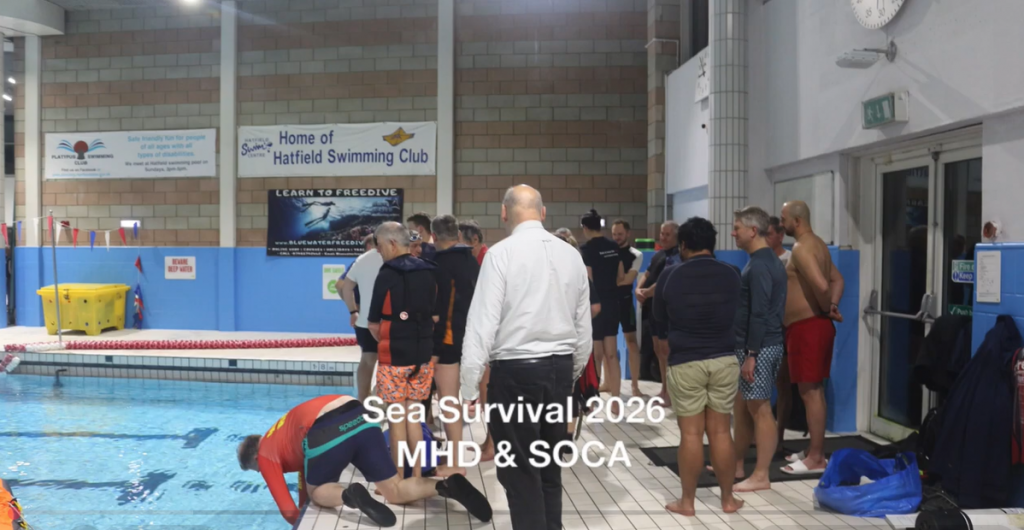
CLICK HERE FOR A SHORT YOUTUBE VIDEO OF THE EVENT
Below are the notes from the training session
SEA SURVIVAL THEORY SESSION
We are not qualified sea survival instructors. We have attended a full day RYA sea survival course at an environmental tank. Other courses are available and there is a multitude of information online.
www.rya.org.uk/course-finder/basic-sea-survival-certificate
www.bsac.com/training/skill-development-courses/safety-and-rescue-courses/rnli-diver-sea-survival-workshop/#tab-1
RNLI Safety information
Float to live:
1 Tilt your head back submerging your ears
2 Relax and control your breathing
3 Move your hands and legs to help you stay afloat
4 Your legs may sink – that’s OK everyone floats differently
5 Practise floating at a supervised location like a swimming pool
https://rnli.org/safety/float
Cold water shock:
If you enter the water unexpectedly: Take a minute.
The initial effects of cold water pass in less than a minute so don’t try to swim straight away.
Relax and Float to Live.
Keep calm then call for help or swim for safety if you’re able.
rnli.org/safety/know-the-risks/cold-water-shock
Yachting & Motorboating:
Safety checklist:
Always wear an appropriate lifejacket.
Always carry a means of calling and signalling for help.
Ensure there is an emergency action plan in place and everybody has an onboard briefing (in particular on the location and use of the safety equipment, including the spare kill cord for powerboats).
Get the right level of training for your craft.
Always check the weather and tide times.
Make sure someone ashore knows where you are going and who to call if you don’t return on time.
Always drive your boat at a speed that is appropriate to the weather conditions and to the environment you are operating in.
https://rnli.org/safety/choose-your-activity/yacht-sailing-and-motorboating
Scuba Diving:
6 safety checks for scuba diving:
1 Be fit to dive: Be fit to dive – cold water will put extra strain on your body. Always consider your cardiac health before diving and get any concerns checked out.
2 Check your diving equipment: At the start of the season make sure all your diving gear is in service and ready for another year’s diving.
3 Plan your dives: Check the weather and tides. Tide tables and sea conditions for the UK and Ireland at metoffice.gov.uk.
4 Always complete a buddy check: No matter how experienced you are, or however many times you have dived with your buddy, don’t skip the buddy check. It could save your life, and theirs.
5 Be spotted: All divers should carry a surface marker buoy (SMB) or delayed surface marker buoy (DSMB) on every dive to aid their visibility to all surface craft.
6 Carry a means of calling for help: If something goes wrong, how will you call for help? Consider carrying a personal locator beacon (PLB) or similar device in a waterproof canister.
https://rnli.org/safety/choose-your-activity/scuba-diving.
SAFETY EQUIPMENT:
Lifejackets
Crouch straps, Spray hood, whistle, light
A well fitted and suitable lifejacket can rotate you and keep your airway clear of the water.
Preventing Downing/Secondary drowning.
Help position in water (Heat Escape Lessoning Posture)
More safety equipment
First Aid MOB kit
Communication Grab bag
Flares
Liferaft
Fire extinguishers
PLB/Epirb
WHAT TO DO IN AN EMERGENCY:
Are you in distress?
Serious and imminent danger to life
Collision causing foundering, life threatening injury, fire, or MOB
This is a mayday call
Radio usage, mayday call, Lifeboat and helicopter rescue MHD
Shout Man overboard
Keep pointing at the casualty
Throw MOB equipment
Press MOB button on GPS
Manoeuvre vessel
Early Mayday call
Retrieval equipment/Methods of retrieval
Abandon Ship
Mayday
Lifejackets, flares
Seasickness pills and water
Warm clothes
Grab bag
Liferaft is the last resort but prepare it early
Try not to get wet, step into life raft
Entering the water
Wear lifejacket
Hold jacket and cover airway
if possible enter slowly
Grab bag Waterproof floating container
VHF & GPS Water & Energy bars
Torch Multitool
First aid Kit medication
(Phone, Credit card, car keys, passport)
Lists on the internet
Life raft what’s inside? Typical leisure raft
Knife, Bailer, Sponges – collect condensation for drinking,
Sea anchor, paddles, repair kit, throwing line
Life raft righting Stand on cylinder
Take care with moving & handling
SEA SURVIVAL POOL SESSION
We all like to think we’re competent on the water.
We’ve got the kit.
We’ve got the training.
We’ve watched the YouTube from the sofa.
But no one plans to use a life raft.
It’s the most expensive bit of equipment you hope never to use.
Sailors trust their boats.
Divers trust their buddies.
But when things go wrong, they go wrong fast — and cold water doesn’t care how many qualifications you’ve got.
Tonight It’s about answering one simple question:
If you had 60 seconds before abandoning your vessel… would you actually know what to do?
Would you inflate at the right moment?
Could you turn a raft over alone?
Could you get in safely?
Would your lifejacket fit properly?
Survival at sea isn’t about strength — it’s about preparation and staying calm when your brain is trying to panic.
Tonight we’re going to: Inflate a few rafts
Get wet
Turn them over
Climb in
And maybe prove that it’s harder than we all imagine.
More than 20 people attended, from SOCA, BOSG and 2 local diving clubs. All that attended agreed it was a worthwhile event.
Life Raft & Survival Quiz
1 Should you inflate a life raft inside the cabin?
A) Yes, safer out of the wind
B) Only in calm conditions
C) No
Answer: C (Unless you want a very expensive orange interior
redesign.)
2 If your boat is still floating but disabled, should you:
A) Immediately abandon ship
B) Stay with the vessel if safe
C) Swim for shore
Answer: B. A boat is bigger, easier to spot, and usually safer than a
raft.
3 In UK waters (10–15°C), how long before cold water seriously affects you?
A) 10–15 minutes
B) 1 hour
C) 3 hours
Answer: A. Cold shock and swim failure happen frighteningly fast.
4 Can one reasonably fit adult right an inverted life raft alone?
A) Yes
B) No
Answer: Yes — but technique matters. (demonstrate later.)
5 Should you inflate your lifejacket before entering the water from a sinking vessel?
A) Yes
B) No
Answer: No It makes movement and escape much harder.
Life Raft practical
4 Groups
DEMO lifejacket auto inflate for unconscious Help position
DEMO Secure the painter
Inflate 2 liferafts
ALL Enter liferafts from Shore
Remove contents from liferafts
Seal liferafts
Shore crew free liferafts
Paddle liferafts
Exit to water
Float to live
Upturn liferaft
Righting an upturned liferaft
Enter liferaft from Water
Use throwing line to casualty
Paddle liferafts to exit
join together
remove liferafts from water
Safety Diver to recover any flotsam
Dry liferafts, clear away
Debrief – Life Raft Evening
This session wasn’t about proving who’s strongest, fastest, or best at hauling themselves into an orange bouncy castle.
It was about reducing panic.
When something goes wrong at sea, it’s rarely the equipment that fails first.
It’s decision-making.
Cold water steals your breath.
Noise steals your concentration.
Confusion steals time.
And time is everything.
We saw that rafts inflate violently.
Turning one over takes technique, not muscle.
Boarding is harder than it looks.
The people who survive at sea aren’t superheroes.
They’re the ones who rehearsed the boring stuff before they needed it.
So whether you’re under sail or under bubbles
Check your kit.
Practise your drills.
Talk through scenarios before you leave harbour.
You’ve added a little more training.
Hopefully you’ll never need it.